


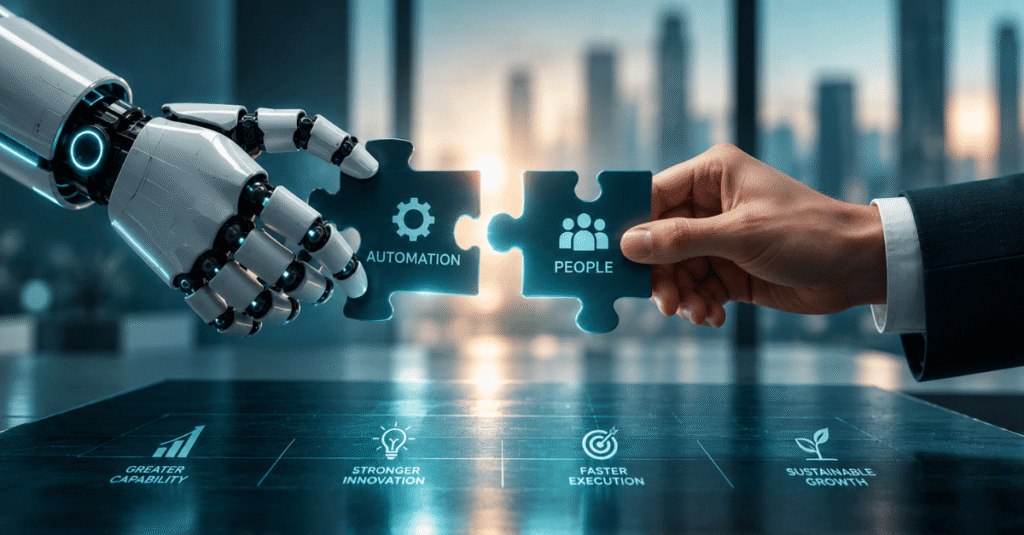
Embedded Workforce thinking becomes more important when technology changes not only how work gets done, but also where human capability creates the greatest value. For years, organizations have pursued automation primarily to improve efficiency, accelerate processes, and reduce repetitive work. But efficiency alone does not create lasting advantage. The bigger opportunity is emerging from what happens after work is automated: how people use the capacity created, how roles evolve, and how organizations strengthen the judgment, expertise, and adaptability that technology cannot replace.
Workforce Strategy Must Look Beyond Automation
Automation can change tasks quickly, but organizations cannot assume their workforce will automatically evolve with them.
A modern Workforce Strategy needs to examine how technology changes roles, skills, workflows, and decision-making responsibilities. When routine activities are reduced, employees may need to contribute in different ways—solving more complex problems, working across functions, interpreting information, or applying deeper business judgment.
The workforce question therefore changes from “What work can we automate?” to “What should people become capable of doing next?”
That distinction is important because technology creates greater value when workforce capability develops alongside it.
Talent Assessment Reveals Readiness for Changing Work
As roles evolve, traditional measures of experience may provide an incomplete picture of workforce readiness.
Talent Assessment can help organizations understand whether employees have the adaptability, learning potential, leadership capability, and transferable strengths required for changing responsibilities.
This visibility matters when existing roles begin to shift. Some employees may possess capabilities that can be redirected toward higher-value work, while others may require focused development to succeed in a different environment.
Instead of assuming automation automatically creates productivity, organizations can identify whether people are prepared to use the opportunity it creates.
Strategic Talent Becomes More Valuable as Routine Work Declines
As technology takes on more repeatable activities, human contribution can become increasingly concentrated around judgment, creativity, collaboration, leadership, customer understanding, and specialized expertise.
This changes how organizations should think about Strategic Talent.
Critical talent will not simply be the people who perform today’s processes most efficiently. Greater value may come from individuals who can connect information, navigate ambiguity, solve unfamiliar problems, and apply expertise across changing business situations.
Organizations that recognize these capabilities early can develop and position talent around areas where human contribution remains strategically important.
Embedded Workforce Adds Capability Where Transformation Creates Gaps
Technology-driven change rarely affects every part of an organization at the same speed. New requirements can emerge quickly while internal capability takes longer to develop.
An Embedded Workforce can help bridge that gap by bringing specialized expertise directly into existing teams and business environments.
This provides organizations with access to capability during transformation without assuming every emerging skill must immediately become a permanent role.
More importantly, embedded expertise can work alongside internal employees, contributing knowledge while helping existing teams adapt to new ways of working.
The result is not simply additional capacity. It is a more flexible approach to capability building.
Workforce Strategy Should Redesign Work, Not Just Reduce Tasks
The greatest opportunity from automation may not come from removing work. It may come from redesigning it.
A stronger Workforce Strategy considers which activities technology should handle, where human oversight remains essential, and how roles can be reorganized around higher-value contribution.
This could mean giving employees greater responsibility for decision-making, customer relationships, problem-solving, innovation, or cross-functional collaboration.
Rather than designing technology around existing jobs, organizations can reconsider how work should flow between people and systems.
That is where automation begins to become workforce amplification.
Growth Catalyst Thinking Reinvests Productivity into Capability
Efficiency gains create choices. Organizations can treat them purely as cost savings, or they can use part of that capacity to strengthen what the business can do next.
A Growth Catalyst mindset focuses on the second opportunity.
Time and productivity released through automation can be redirected toward capability development, new services, customer opportunities, innovation, leadership, and transformation.
This creates a compounding effect. Technology improves productivity, while stronger human capability creates additional business value from those improvements.
The advantage therefore comes not simply from doing existing work faster, but from using greater capacity to pursue opportunities that were previously difficult to address.
Talent Assessment Helps Protect Human Judgment
Greater automation also creates a less obvious workforce challenge: organizations must understand which human capabilities should remain central to important decisions.
Experience, context, institutional knowledge, and judgment can be difficult to reproduce through systems alone.
Regular Talent Assessment can help organizations identify where these capabilities exist and where they may be vulnerable through workforce transitions, restructuring, or changing roles.
Protecting critical knowledge does not mean resisting technology. It means ensuring that technological progress does not unintentionally remove the expertise required to interpret situations, challenge assumptions, and make sound business decisions.
Strategic Talent Must Be Prepared to Adapt, Not Just Perform
In a rapidly changing environment, today’s expertise may not remain sufficient indefinitely.
Organizations therefore need Strategic Talent that can continue learning as roles and workflows evolve. Adaptability becomes especially valuable because employees may need to work across disciplines, use new tools, and apply their expertise in situations that did not exist when their original roles were designed.
This shifts development from preparing people for a fixed career path toward building capabilities that can move with business needs.
The stronger the organization’s ability to develop and redeploy talent, the more value it can create from technological change.
Growth Catalyst Turns Workforce Amplification into Advantage
Automation becomes strategically meaningful when it increases what the organization is capable of achieving.
A Growth Catalyst approach connects technology investment with workforce readiness, capability development, and future opportunity. Instead of measuring progress only through tasks automated or costs reduced, organizations can consider whether people are making better decisions, solving more valuable problems, and contributing to new sources of growth.
The workforce amplification era is therefore not about choosing between people and technology. It is about designing an organization where each strengthens what the other can accomplish.
How Pragna Solutions Helps Organizations Amplify Workforce Capability
At Pragna Solutions, we help organizations connect changing business requirements with the capabilities needed to execute them. Through Embedded Workforce, Workforce Strategy, Talent Assessment, Strategic Talent, and Growth Catalyst, we help leaders understand workforce readiness, identify critical capability gaps, strengthen talent decisions, and create flexible workforce models that can evolve alongside technology and business priorities.
Move Beyond Automation with Pragna Solutions
Technology can create efficiency, but competitive advantage depends on what organizations do with the capacity it creates. Businesses that strengthen human judgment, develop adaptable talent, redesign work, and position critical expertise around emerging opportunities can turn technological change into greater organizational capability.
📩 Connect with Pragna Solutions today to discover how stronger workforce planning and capability development can help your organization move from simply automating work to amplifying what your workforce can achieve.