


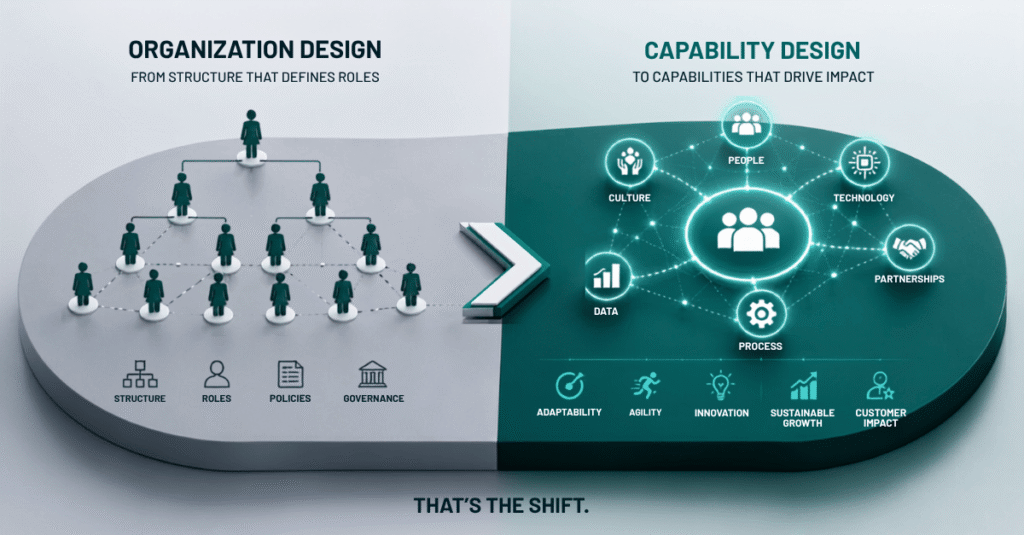
Embedded Workforce is becoming part of a broader shift in how organizations prepare for growth, transformation, and continuous change. For years, business consulting often focused on organization design—defining structures, reporting lines, roles, and responsibilities to improve how work gets done. Those elements still matter, but structure alone cannot guarantee performance. Organizations increasingly need to understand whether they have the capabilities required to execute their strategy. This is driving a shift toward capability design, where leaders focus not only on how the organization is structured but also on the skills, leadership, expertise, decision-making, and workforce capacity needed to deliver business outcomes.
Workforce Strategy Moves Beyond Organizational Structure
Traditional organization design typically focuses on creating clarity around functions, teams, roles, accountability, and reporting relationships. A strong Workforce Strategy goes further by asking whether those structures contain the capabilities required to execute future business priorities.
An organization may have clearly defined teams and responsibilities but still struggle if critical skills are missing. Similarly, creating new positions does not automatically create the expertise required to perform them successfully.
Capability design begins with the business outcome and works backward. Leaders identify what the organization needs to accomplish, determine the capabilities required to achieve it, and then decide how people, roles, processes, and workforce models should be structured around those capabilities.
This creates a stronger connection between organizational design and business performance. Instead of asking only, “What should our structure look like?” organizations begin asking, “What must we be capable of doing?”
That difference is becoming increasingly important as businesses navigate faster market change and more complex strategic priorities.
Strategic Talent Builds Capability Around Business Priorities
Capability design also changes how organizations approach Strategic Talent. Traditional workforce planning often begins with positions that need to be filled. Capability-led planning begins by identifying the expertise and behaviors required to achieve specific business outcomes.
This allows organizations to focus talent investments where they can create the greatest strategic value.
Some capabilities may already exist within the organization but need to be strengthened. Others may require new expertise, leadership development, internal mobility, or specialized external professionals. In some situations, roles themselves may need to be redesigned around changing business requirements.
Strategic talent therefore becomes less about matching people to existing job descriptions and more about creating the combination of expertise required to execute strategy.
This approach can also improve workforce flexibility. As priorities change, organizations can evolve capabilities without necessarily redesigning the entire organizational structure each time.
Talent Assessment Reveals Capability Beyond Job Titles
One of the limitations of organization design is that job titles and reporting structures do not always reveal what people are truly capable of contributing. Talent Assessment helps organizations gain a deeper understanding of skills, strengths, leadership potential, behaviors, and development opportunities.
This insight becomes critical when designing around capability.
Employees may possess valuable skills that are not fully utilized within their current roles. Others may demonstrate the potential to develop capabilities that will become strategically important in the future. Without deeper workforce visibility, these opportunities can remain hidden.
Assessment intelligence helps leaders compare existing talent with future capability requirements. Organizations can identify what they already have, what can be developed, and where external expertise may be required.
This creates a more informed approach to workforce investment. Instead of automatically adding new positions when capabilities are missing, businesses can consider development, internal mobility, role redesign, or targeted talent acquisition.
Capability design therefore helps organizations make better use of the talent already within the business.
Embedded Workforce Adds Capability Without Creating Rigid Structures
An Embedded Workforce provides organizations with another way to build capability without immediately creating permanent organizational structures around every new business requirement.
This flexibility is particularly valuable during transformation, rapid growth, market expansion, or periods when specialized expertise is required quickly. Embedded professionals work alongside internal teams, align with business objectives, and provide targeted expertise while becoming closely connected to the organization’s working environment.
Rather than operating as disconnected external support, these professionals can complement internal capability and contribute directly to strategic priorities.
The approach also supports knowledge transfer. Internal employees gain exposure to specialized expertise, while the organization develops a clearer understanding of whether emerging capabilities should eventually become permanent internal strengths.
This gives businesses more options when designing their workforce. Capability can be accessed, developed, tested, and scaled based on business need instead of automatically creating additional organizational layers.
Growth Catalyst Turns Capability into Business Momentum
Capability design becomes a Growth Catalyst when organizations build the expertise required to pursue opportunities before traditional structures become barriers to execution.
Growth often creates requirements that existing organizational models were not designed to handle. New markets may demand different commercial expertise. New technologies may require specialized skills. Business transformation may create entirely new ways of working.
Organizations that focus only on structure may respond by creating additional teams, roles, or management layers. While sometimes necessary, this can also introduce complexity without solving the underlying capability challenge.
A Growth Catalyst approach starts by identifying what the organization needs to be able to do differently. Leaders can then determine whether the solution requires new skills, stronger leadership, different processes, external expertise, or structural change.
This keeps workforce investment connected to business outcomes and helps prevent unnecessary organizational complexity.
When capability is built around opportunity, organizations can move faster while maintaining greater flexibility.
Workforce Strategy Makes Capability Design Continuous
Capability design is not a one-time transformation exercise. A Workforce Strategy needs to continuously evaluate how business requirements are changing and whether workforce capabilities are evolving at the same pace.
A capability that creates competitive advantage today may become standard tomorrow. New technologies can change how work is performed, while customer expectations and market conditions can introduce entirely new requirements.
Organizations therefore need regular visibility into existing and emerging capabilities. Leaders can identify where skills are becoming outdated, where new expertise is required, and which capabilities should receive greater investment.
This continuous approach reduces the need for large-scale restructuring every time strategy changes. Instead, organizations can make smaller and more deliberate adjustments to skills, talent, roles, and workforce models.
The organization becomes more adaptable because capability evolves alongside business direction.
Strategic Talent and Talent Assessment Create Stronger Capability Decisions
Combining Strategic Talent with Talent Assessment gives organizations a clearer foundation for capability design. One defines which expertise matters most to business performance, while the other provides visibility into the potential already available within the workforce.
Together, they enable organizations to make more informed build, develop, redeploy, or access decisions.
A critical capability may already exist internally but require stronger development. Another may need to be introduced through specialized expertise. Some capabilities may become permanent strategic priorities, while others may only be required during a particular stage of transformation.
Understanding these differences prevents organizations from treating every workforce requirement in the same way.
The result is a more intentional workforce where talent investment follows strategic capability rather than organizational structure alone.
Growth Catalyst Connects Capability Design with Future Opportunity
The greatest value of capability design appears when organizations connect it with future opportunity. A Growth Catalyst mindset encourages leaders to ask not only which capabilities support today’s business, but which ones could unlock tomorrow’s growth.
This changes the role of business consulting. Instead of focusing primarily on optimizing existing structures, consultants can help organizations understand how people, leadership, workforce models, and expertise need to evolve around future strategy.
Capability design creates space for this broader conversation. It connects organizational effectiveness with workforce readiness and helps businesses prepare for transformation before capability gaps begin limiting execution.
As a result, organization design remains important—but it becomes one part of a larger question about what the business must be capable of achieving.
How Pragna Solutions Helps Organizations Design for Capability
At Pragna Solutions, we believe strong organizations are built not only around structure but around the capabilities required to execute business strategy. Through our expertise in Embedded Workforce, Workforce Strategy, Talent Assessment, Strategic Talent, and Growth Catalyst, we help organizations understand existing strengths, identify future capability requirements, and create flexible workforce solutions aligned with business priorities. Our approach connects organizational direction with people, expertise, and workforce readiness so businesses can build the capabilities that matter most.
Build Capability for What Comes Next with Pragna Solutions
The future of business consulting is moving beyond designing where people sit within an organization toward understanding what the organization must be capable of doing. Businesses that connect structure with capability can respond faster to change, invest more intentionally in talent, and build greater resilience around future opportunities. Pragna Solutions works alongside organizations to create workforce strategies that strengthen today’s performance while developing the capabilities required for tomorrow.
📩 Connect with Pragna Solutions today to discover how our Embedded Workforce and strategic workforce solutions can turn capability design into a Growth Catalyst for sustainable business success.